

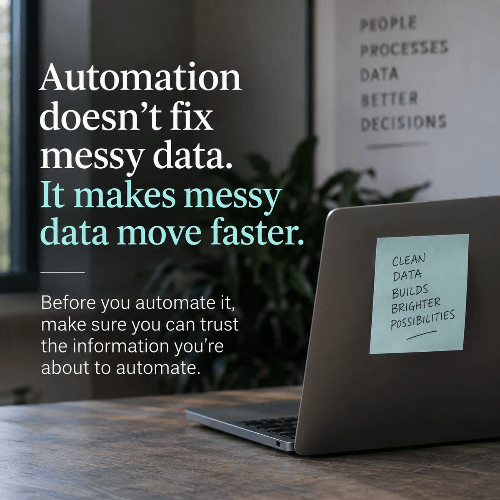
Automation doesn't fix messy data. It makes messy data move faster.
Automation doesn't fix messy data. It makes messy data move faster.
There is a lot of excitement right now around automation and AI, and for good reason, because the possibilities for what businesses can do with their data are pretty incredible, but there is one piece of the conversation that I think gets overlooked far too often: all of those tools are relying on the information we give them.
If your CRM has duplicate accounts, outdated contacts, inconsistent naming conventions, missing information, fields that mean different things to different teams, or years of “we'll clean that up later” living inside of it, adding automation doesn't magically make those problems disappear.
It just gives them somewhere new to go.
One of the biggest things I've learned from working with large business datasets is that messy data is rarely just a data problem. Usually, there is a reason behind it. Different teams developed different processes, fields were created for a need that no longer exists, definitions changed over time, someone found a workaround that made perfect sense in the moment, or the business simply grew faster than the systems supporting it.
That is why I don't think the first question before automation should be, “What can we automate?”
I think it should be, “Do we trust the information we're about to automate?”
Because once you start connecting systems, building workflows, creating dashboards, enriching records or layering AI on top of your existing data, you aren't fixing what is underneath it. You're increasing the number of places that information can influence decisions.
And if the foundation isn't trustworthy, you're just making the mess more efficient.
Before you automate it, clean it up.